Commercial Roofing Service Area: Fontana, CA
Active Fontana properties may need a roof scope that preserves receiving, tenant access, or a public entrance while work proceeds. The first step is to define what the owner needs: stop a leak, document a condition, compare repair with renewal, or sequence work across occupied areas. We ask for the site address, roof plan if available, a description of the symptom, and the access contact. From there we inspect the assembly and map drains, curbs, penetrations, edges, and earlier patches. We do not choose a membrane from the city name. The open layers, attachment, insulation, deck, and drainage determine whether a repair boundary is sound or whether a test is needed. If a building stays active, agree on the work zone and daily close-in point before material is staged.
The citywide numbers and the roof in front of you
Fontana’s 2022 retail sales were $4,362,333 thousand, and transportation and warehousing receipts were $2,292,102 thousand. Those citywide totals make the operating calendar a useful first question, not a roof description. Ask which entries, loading lanes, customer areas, or production shifts must remain open while work proceeds. A high-activity property may need the roof divided into smaller sections, with each tie-in protected at the end of a shift. Confirm the actual use at the address rather than assuming the property matches a citywide economic measure. Keep estimates and photos tied to the building and roof zone they describe. Owners coordinating sites in Rialto or Rancho Cucamonga should keep those municipal files separate from the Fontana condition record.
Map the symptom to a roof detail
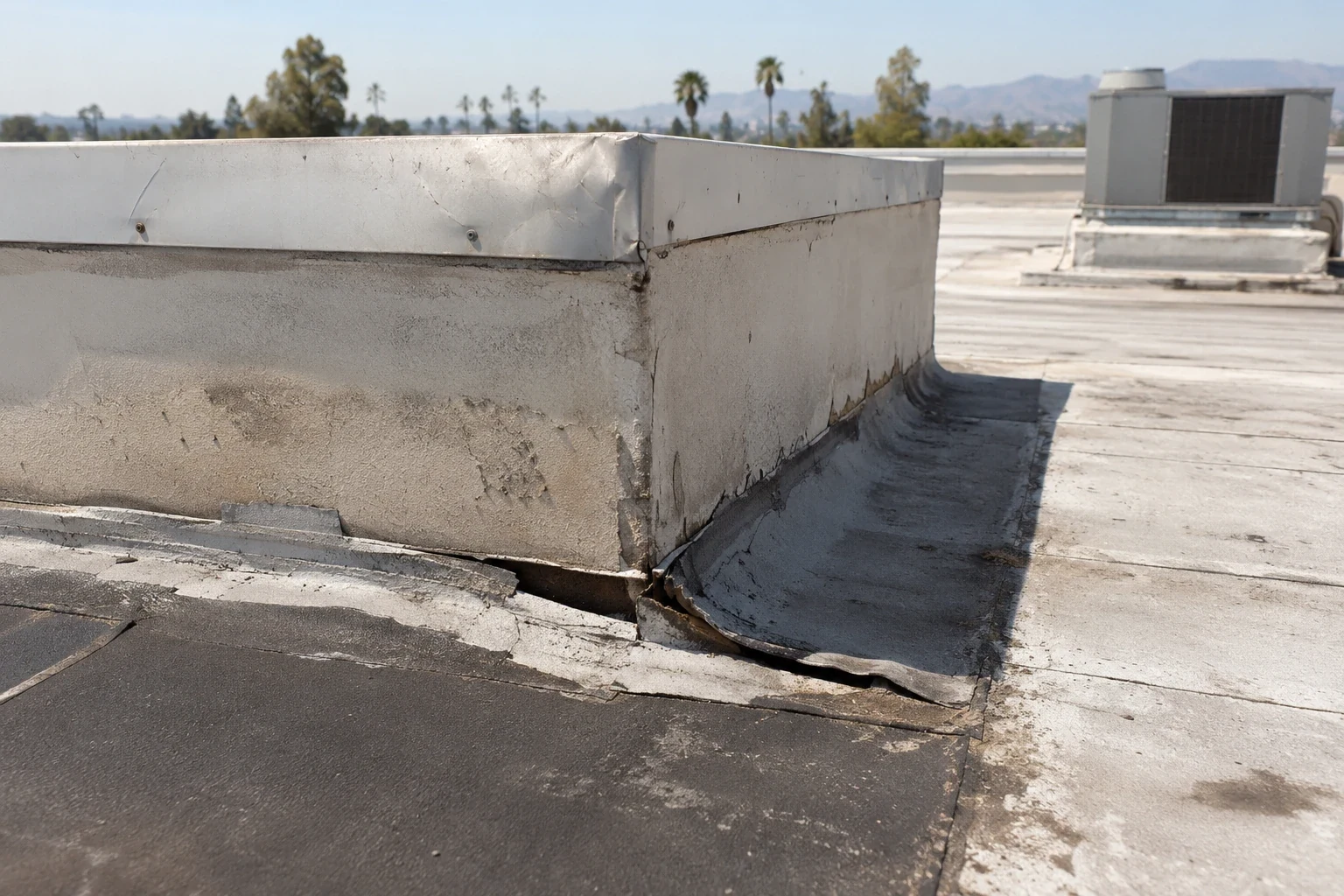
A leak report becomes useful when it includes time, location, and what happened after a prior repair. Note the room or equipment affected, whether water appeared during or after rainfall, and whether the symptom moved. On the roof, trace the nearest drain path, seam, curb flashing, wall transition, penetration, and edge metal. Water can travel through insulation or along a deck before reaching the interior. If a test opening shows wet material beyond the visible mark, expand the investigation only to the area supported by evidence. A flashing repair addresses an open transition; a ponding-water assessment looks at drainage and deflection. Separate those findings rather than pricing a broad patch that leaves the cause unclear.
Compare work against the confirmed assembly
The inspection should record both the roof condition and the limits of what could be reached. We photograph seams, drains, curbs, penetrations, perimeter details, and repair history, then mark roof zones on a plan. Drone imagery can help show extent or access constraints. Infrared moisture scanning can guide where to investigate if the assembly and conditions suit the method; a test opening confirms what layers are present. If a survey cannot distinguish wet insulation from a surface pattern, describe that uncertainty and the next test instead of treating an image as a diagnosis. A moisture survey can support an inspection plan, while a written condition report keeps findings, photos, and repair limits connected to the Fontana property.
Set the work window before staging
An operating property needs a work sequence that preserves the routes the owner chooses to keep open. Identify roof access, restricted areas, staging space, crane or equipment coordination if applicable, tenant notice, and interior protection before mobilization. The field lead also needs the person who can approve a change if tear-off exposes wet insulation or deck damage. Our emergency response remains available around the clock, including weekends and holidays; no arrival time can be set from a city name alone. A phased occupied-building reroof should show the section released, temporary protection, and close-in point for each shift. Where distribution activity is present, logistics roof coordination can keep dispatch, receiving, and roof access on one operating calendar.
Compare the repair boundary with renewal
A repair is appropriate when the observed defect has a practical tie-in and the surrounding assembly can support it. A recover should account for moisture, attachment, drainage, and added layers before the owner compares cost or schedule. Coating depends on preparation, adhesion, compatible details, and whether the substrate is sound. Replacement planning makes the removal depth, insulation, deck contingencies, edge metal, drains, and rooftop equipment interfaces explicit. Each option should state the evidence behind it and the finding that would change it. If the existing assembly is suitable, EPDM roofing may be one of the systems considered, alongside other tested options. A roof coating restoration proposal needs a defined preparation standard, not just a coverage area.
Return the findings to the property file
At closeout, the owner should be able to compare the approved scope with the roof section completed. Return marked locations, tie-in and detail photos, material information, approved field changes, and items deferred for further testing. Keep tenant reports alongside the date and zone checked so a later complaint does not reopen an unrelated area. For a portfolio, use consistent labels for each building while preserving separate roof histories and warranty documents. A warranty record should identify the system and the maintenance or repair documentation the owner retains. The best next decision for a Fontana building may be a localized repair, a test opening, or a scheduled renewal; the inspection needs to show why. If the record leaves a section unobserved, mark that gap plainly and assign the next access step.
At the last walkthrough, compare completed details with the marked scope and record any remaining maintenance item. The owner can then close the phase or assign a dated follow-up.
If a work window is too short to close a full roof bay, split the scope into smaller measurable sections and state what temporary tie-in protects each one. The owner can then approve a sequence that matches the building calendar without leaving the completion point unclear.
A useful work order identifies more than the address. Name the roof zone, the condition that triggered the request, the room or operation below, and the record that will confirm the repair is complete. If the owner is comparing several buildings, use the same fields for each but do not copy a repair boundary from a different property. Roof age, membrane type, insulation, and drainage can vary even when buildings share an operator. When tear-off exposes concealed damage, pause at the agreed approval point, photograph the open layers, and document the quantity before work expands. The daily report should also record weather conditions that affected the close-in, temporary protection, and any access restriction carried into the next shift. This keeps a field change tied to an observable condition and gives finance a clear basis for reviewing the added work. At completion, reconcile the marked plan with the installed detail and any deferred test area.
Commercial Roofing Questions
How can a roof repair be phased around Fontana operations?
We identify the roof section, entry routes, receiving windows, and protection needs, then mark the daily close-in point and any area that needs an owner-approved shutdown.
What does a moisture survey establish?
It can help target testing when the roof assembly supports the method. A test opening confirms the concealed material and sets a defensible removal boundary.
Can the same roof scope be used at several Fontana properties?
Use one reporting format, but inspect each address separately. Membranes, drains, repairs, and deck conditions can differ between buildings.
What can change a replacement estimate after tear-off?
Wet insulation, deck deterioration, attachment conditions, and concealed curb or edge details can change quantities. The estimate should state how an added scope is approved.
Is emergency service available overnight?
Our emergency response runs day and night, including weekends and holidays. The address, reported condition, and safe access contact help coordinate the initial response.