Commercial Roof Drains and Scuppers in Hesperia, CA
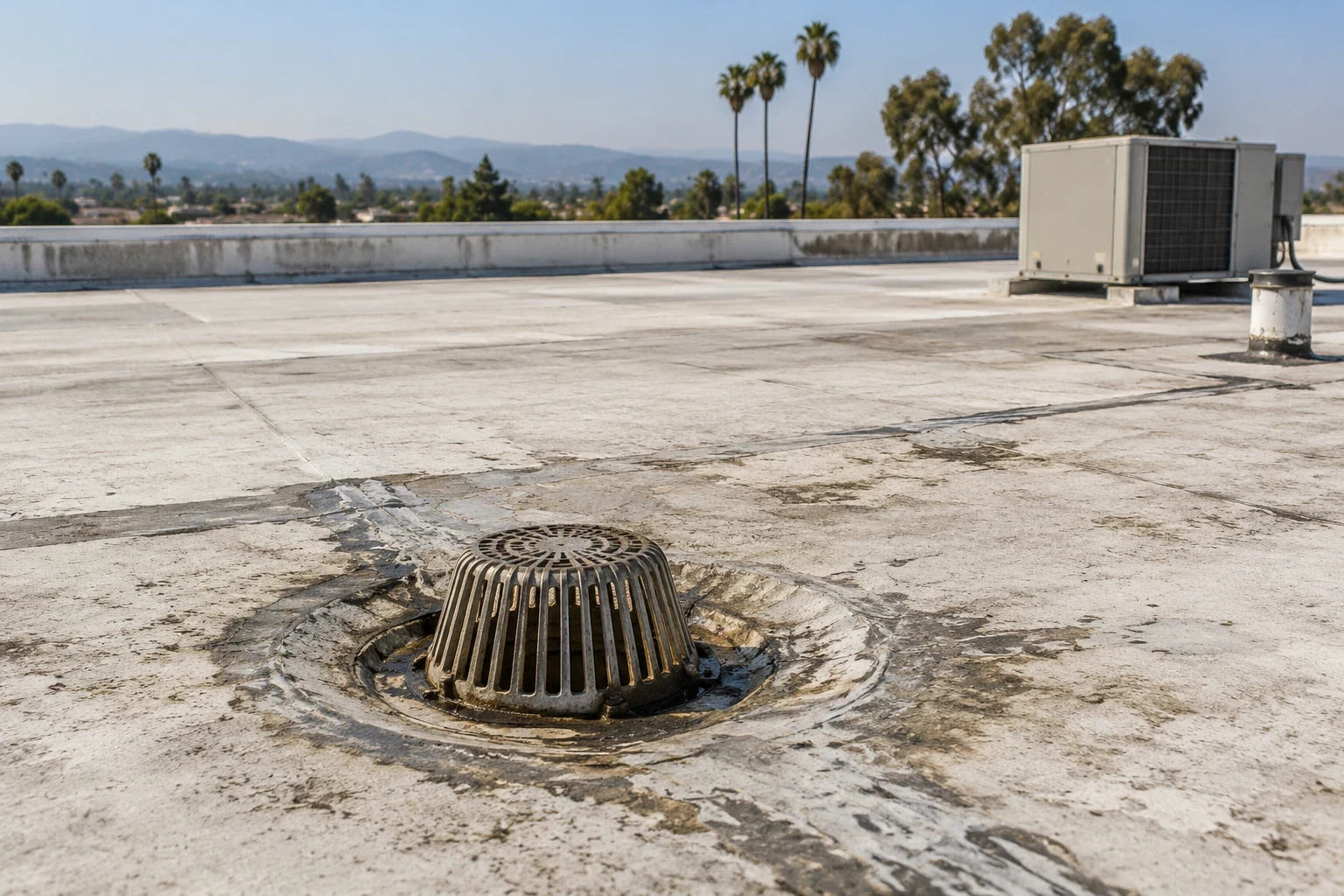
A drain can be clear at the grate and still fail to move water off the roof. Start by checking the basin, strainer, outlet, overflow, and the path that feeds each opening. Look for debris, loose rings, ponding, separated flashing, or a scupper discharge that cannot drain freely. The Hesperia 2 E station’s December normal precipitation is 1.23 inches. We inspect the drain path and overflow details before the next work window. A blocked outlet or poorly connected detail can make a modest rainfall a problem inside a building. We inspect the whole drainage path and note whether the issue is maintenance, a failed connection, or a roof geometry concern. If water remains after the outlet is clear, a roof inspection can map the surrounding section and define the next test.
Follow the Water to the Outlet
Trace the drainage path from the field toward the drain. Note low areas, debris traps, equipment pads, seams, and repairs that may slow flow. Remove loose debris only when the method is safe and will not push material into the pipe or damage the membrane. Check whether a strainer is seated and whether the outlet appears open. A roof drain includes the membrane connection and bowl, not only the visible cover. Scuppers need an unobstructed opening, sound metal or membrane flashing, and a clear discharge beyond the wall. A roof in Hesperia's City Center District may have different surrounding use than one near an industrial corridor, but the drainage diagnosis still follows the actual assembly and slope. Record where water remains and how long it persists after ordinary drainage time.
Check the Secondary Route
Overflow details limit the consequences of a primary drain problem only when their entry point and discharge remain clear. Confirm the overflow level relative to the roof surface, inspect the opening and flashing, and verify that the outlet does not discharge onto an entrance or equipment area. Do not block the secondary path with a screen, sealant, or temporary cover. If the overflow shows staining or corrosion, record that condition and check the connected wall detail. An open scupper alone does not prove that water can flow through its full path. The owner may need a plumber or other trade if the problem is below the roof connection. Keep the roofing scope limited to the membrane, flashing, bowl, or wall transition that is actually inspected. A repair scope should identify which part of that path is included and what remains outside the work.
Inspect the Membrane Transition
Drain and scupper failures often occur at the transition between the roof field and the opening. Look for a loose clamping ring, deteriorated sealant, separated flashing, cracked metal, lifted membrane, or patches that bridge a moving joint. Confirm the roof system before selecting a repair material; a TPO drainage detail needs compatible membrane preparation. A thermoplastic membrane, built-up roof, and metal edge need different preparation. If the drain basin is secure but insulation is wet, the repair may extend beyond the visible ring. Use a selective opening only to answer a decision and with owner approval. A targeted moisture survey may help locate comparison areas when weather and assembly allow. If the roof has broad drainage or slope issues, compare the detail repair with a larger replacement scope rather than assuming a new drain will correct the entire field.
Plan Around Hesperia Site Use
Hesperia’s Industrial District and Highway 395 and I-15 District are distinct commercial areas. In 2025, Hesperia approved three entitlement applications covering four industrial warehouse buildings with about 720,000 square feet combined. For drainage work, identify the actual building, roof size, and loading access before setting the inspection path. For a working facility, confirm whether drain access sits above active storage, production, or tenant areas. Keep equipment and debris away from loading routes. The I-15 and U. S. 395 access corridors meet near Hesperia. The operator confirms the property's delivery gate and staging rules. The Industrial District roof review remains a geographic reference, not a substitute for a property-specific drainage map.
Set a Repair Boundary
Before work, identify whether the problem is a clog, loose component, failed membrane connection, blocked discharge, or inadequate slope. Price the confirmed area and describe any concealed condition that could enlarge it. A drain replacement may require interior coordination if the bowl connects through occupied space. A scupper repair may include sheet metal, wall flashing, and exterior discharge control. Separate those tasks rather than grouping them under a general label. State who will remove and replace the strainer, how debris will be handled, and whether water will be used to test the repaired path. The test should not flood a roof or building. If the detail is repaired, photograph the connection and update the roof plan with its location. A maintenance visit can revisit the same drain and compare its condition after a later rain.
Leave the Outlet Ready for the Next Visit
Closeout should state the drain or scupper inspected, what was removed or repaired, whether flow was checked, and any remaining limitation. Include a photo of the basin or opening and one that shows its roof-zone location. Record how water exits the building and whether the discharge needs further observation. If several outlets serve one roof, use the plan to identify each one consistently. The Hesperia 2 E station’s December precipitation normal is 1.23 inches; we keep drains and overflow paths clear before forecast weather. The owner should assign a person to check access and report a change in ponding or interior water. Send the site address, roof plan if available, recent leak notes, and access contact. We will identify the drainage section to inspect and separate maintenance from roof repair.
Compare the Same Points Later
Use the same roof-zone labels at follow-up. Note the water line, sediment, strainer position, and any change at the flashing or clamping ring. If cleaning restores flow, record what was removed and when the work occurred. If a drain is still slow, identify whether the outlet, branch, or roof geometry needs another trade. This comparison is more useful than an isolated photo with no date or location. The property manager can add the check to the next maintenance record and report a new interior mark before it spreads.
On a property with several roof sections, label each outlet so a return visit can distinguish separate drainage paths. Record whether the bowl was clear, whether its strainer was seated, and whether discharge was observable at the time. These details help diagnose a recurring call without assuming every wet area has the same cause.
Commercial Roofing Questions
Why does water remain when the drain is not blocked?
The cause may be a low area, slope or deck deflection, an undersized path, or a connection issue. Map where water sits and how long it remains, then inspect the feeding path and drain detail before choosing work.
Should a roof drain be tested with a hose?
Only when the roof and drainage path can safely handle the test and the owner approves it. The test should answer whether the repaired connection moves water without risking interior damage or flooding the roof.
Can a coating repair a leaking drain?
A coating may be part of a compatible detail system, but it will not secure a loose ring, correct slope, or repair a failed connection by itself. Inspect the basin, membrane, overflow, and discharge before selecting a method.
What should Hesperia facility staff photograph?
From a safe position, capture the water location, the drain or scupper, the roof-zone context, and any interior stain. Include timing and whether water remained after drainage. Do not enter a roof or ceiling hazard to improve an image.