Government Building Roofing in Hesperia, CA
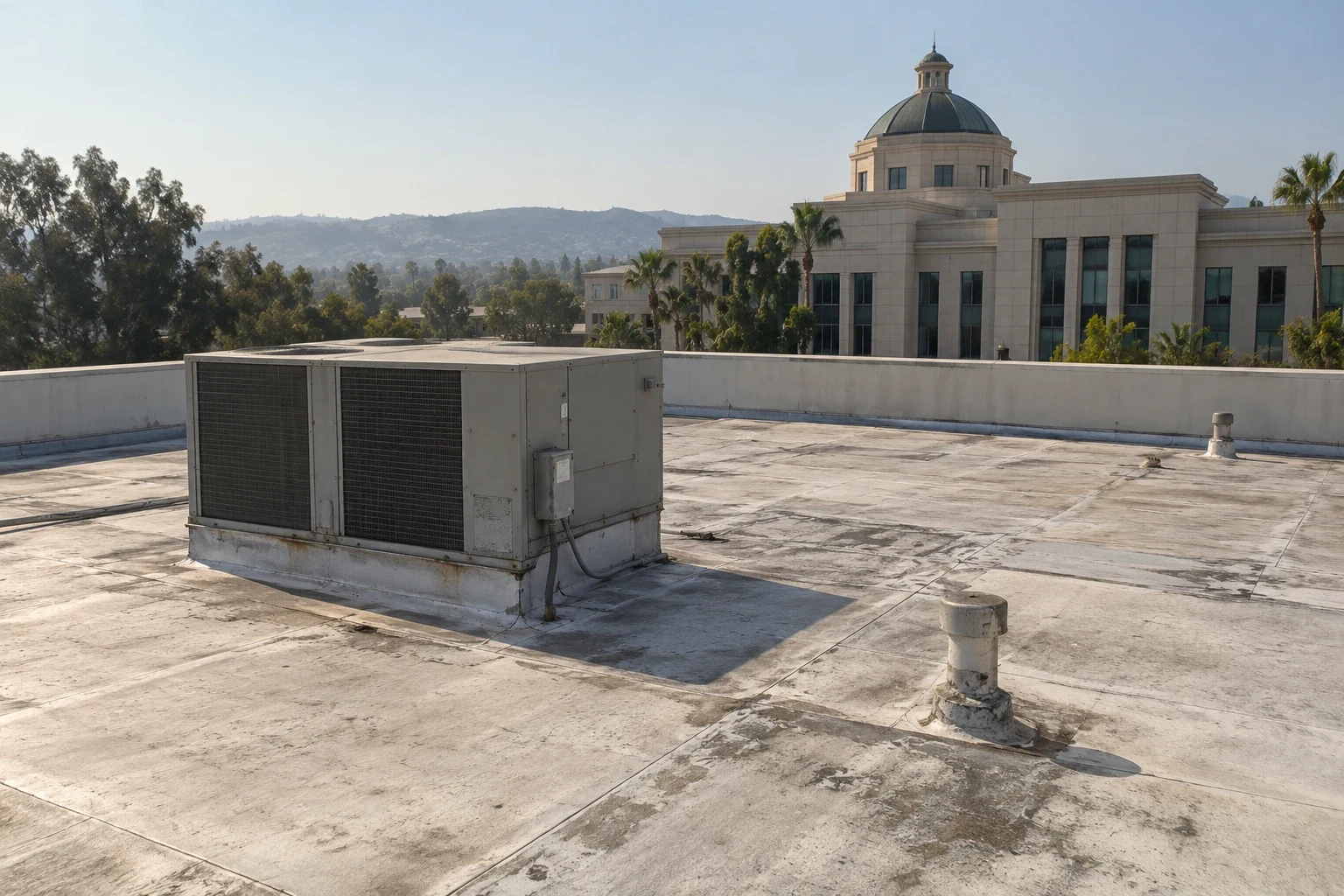
A leak in a public building can affect staff work, public access, records, and scheduled services at the same time. The roof scope has to identify the defect and the operating constraints together. A government roof project in Hesperia has to fit public access, department approvals, and the observed roof condition. Three applications approved in Hesperia in 2025 represented four industrial warehouse buildings and approximately 720,000 square feet. The roof scope at a government property starts with its own plans and inspection. Those are local planning facts, not a description of any individual public building. For a government property in Hesperia, we document the roof condition and define the work area before recommending a repair or replacement.
Define the facility and roof scope
Public properties range from offices and service counters to maintenance buildings, community rooms, and operations space. Roof assemblies can vary across additions and wings, so the first task is to establish which section is involved. We review plans and maintenance records, inspect the accessible roof, and note drains, scuppers, parapets, edges, penetrations, and rooftop equipment. The report distinguishes observed conditions from areas that remain concealed. This gives the owner a clear basis for scoping the work and avoids treating an isolated flashing failure as evidence that the full roof needs replacement.
A public facility also has access rules. We identify roof entry, escort requirements if any, public entrances, loading areas, and spaces that cannot be interrupted. The project contact can confirm procurement and approval steps; we provide a scope that describes materials, repair boundaries, schedule assumptions, and close-in requirements. If the work is part of a solicitation, the bid documents should tie each line item to a roof section and an observable condition. That makes proposals easier to compare and gives inspectors a record to match against completed work.
Keep routes and services in view
Set work controls with the facilities or procurement lead before scheduling a crew. Confirm sign-in, escorts, public hours, restricted records areas, fire lanes, and who can authorize a scope change after demolition. The property plan determines delivery access and staging; Hesperia's citywide freight routes only help orient regional movement. A service-area page for Hesperia City Center describes the wider local setting, while agency security instructions govern entry. Record the reopening time for each affected entrance and use a daily work log to show what remained open. Climate normals provide background only; job-day readings and product requirements control application decisions.
The Hesperia Freeway North District and Main Street-West District are broad planning areas; neither sets the agency's access rules.
Make the evidence reviewable
A sound roof decision begins with repeatable notes. We photograph the affected area, identify the roof section, mark the repair boundary, record the drainage path, and connect those observations to the interior symptom. If water has moved beyond the visible stain, we document where additional testing is needed. Moisture scanning can help locate suspect insulation, but a controlled opening may be necessary before deciding how much material to remove. We explain what each test can establish and how the result would change the scope.
The repair record should be useful to a facility manager after the crew leaves. It can show the materials used, where the tie-in was made, which drain or penetration was involved, and any condition left for monitoring. For a replacement, the record should also identify substrate repairs, insulation changes, attachment, edge details, and the sequence of close-in points. Our roof condition reports keep observations legible for future capital planning. A commercial roof inspection can establish the baseline before a procurement package is prepared.
Write an executable scope
A narrow repair scope describes the defect, the material to remove, the area to prepare, and the compatible patch or flashing detail to install. It also defines how the finished work will be checked. A broad scope should separate inspection, test openings, repair allowances, and replacement areas where the evidence supports them. This avoids pricing a hidden condition as if it were already confirmed. We can provide a written estimate with photographs so a public owner can route the work for review and preserve a clear approval trail.
When a roof needs replacement, sequencing is part of the bid. We set work zones, daily weather-tight close-in points, access routes, and any mechanical coordination needed to protect services. Existing insulation and deck conditions can change after removal, so the documents should state how concealed damage is recorded and approved before added work proceeds. A recover may be considered only when the existing assembly is dry, attached, and acceptable for another layer. Our commercial roof replacement scope can distinguish the base work from conditions requiring owner approval.
Preserve a decision trail
A public owner needs enough detail to decide what happens next: repair now, test a suspect area, include a section in a capital project, or monitor a condition that is not yet leaking. We state the urgency, the evidence, and the consequence of waiting in practical terms. A repair proposal should not obscure the difference between a confirmed defect and an allowance. If multiple buildings are in a program, each gets its own roof record and work boundary, even when the procurement is combined.
Hesperia’s corridor plan includes civic, regional-commercial, industrial, and business-park districts. For a government building, the site contact confirms the responsible department, public hours, purchasing approvals, roof assembly, and maintenance history. We make those determinations through inspection and available records. With a documented scope, the facility can coordinate approvals, budgets, and occupants before work begins. A preventive maintenance plan can then address drains and details between major projects, while TPO system work is considered only if the roof assembly and project requirements support that selection. The same records approach works for public office roofs and school buildings, with each property receiving its own findings and boundary.
Commercial Roofing Questions
Can you write the scope so procurement can compare bids?
Yes. We can describe the roof section, observed defect, repair boundary, materials, access assumptions, close-in requirements, and the conditions that need owner approval. If concealed moisture could change quantities, the documents should state how the opening and review will occur. Clear line items help evaluators compare the same work rather than different assumptions.
What records should be retained after a public roof repair?
Keep the inspection report, marked roof plan, before-and-after photos, material information, repair location, and any closeout notes. Those records help maintenance staff identify the next review point and give future bidders an accurate history. If a test opening found wet insulation, preserve the dimensions and the repair limits as well.
Can the building stay open during replacement?
That depends on the roof zone, public routes, weather, noise, and the facility’s operations. We can phase removal and close-in to protect unaffected areas, then coordinate entrances and deliveries with the site contact. The work plan should name any temporary restrictions before mobilization. It should not promise that every space remains available under every condition.
How do you handle concealed damage in a public contract?
We document the exposed condition, stop at a safe weather-tight point, and provide the owner with photos, dimensions, and a proposed correction for approval. The contract can define how allowances or change requests are reviewed. That keeps concealed work visible in the record and avoids silently expanding a repair boundary.
What is needed for the initial roof review?
Provide the address, available plans, prior repair or inspection records, the reported leak location, and a facility contact who can confirm access and public-hour constraints. We review those materials to prepare a focused inspection. The roof visit establishes actual conditions that records alone cannot show.